Magnetism and phase transitions
When can a single line of spins order?
Every pair of spins on the line interacts, and the pull weakens with distance as a power law.
Cells of three spins are replaced by single spins that follow the majority, again and again, to see what survives at large scales.
The line orders above absolute zero when the pull fades slowly enough. The transition temperature falls as it fades faster, and past the inverse-square case (a = 2) no order survives.
A chain of spins changes character when distant pairs can still feel each other. By tuning how quickly their interaction fades with distance, we can ask when an entire line of spins will order at a temperature above absolute zero.
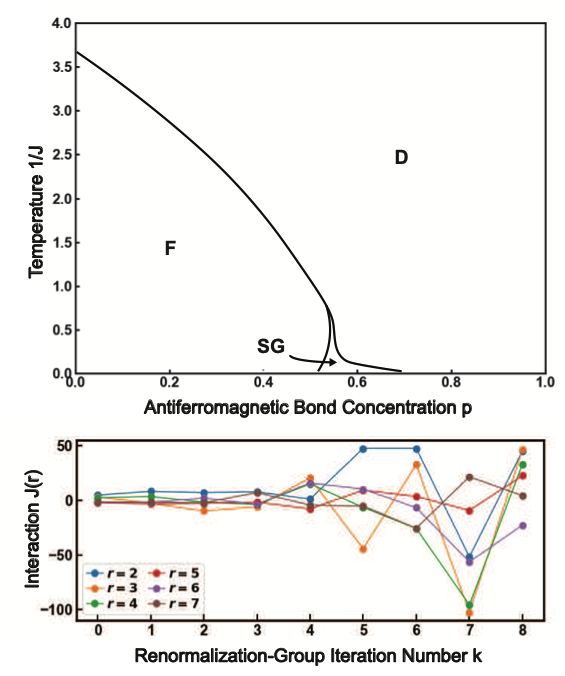
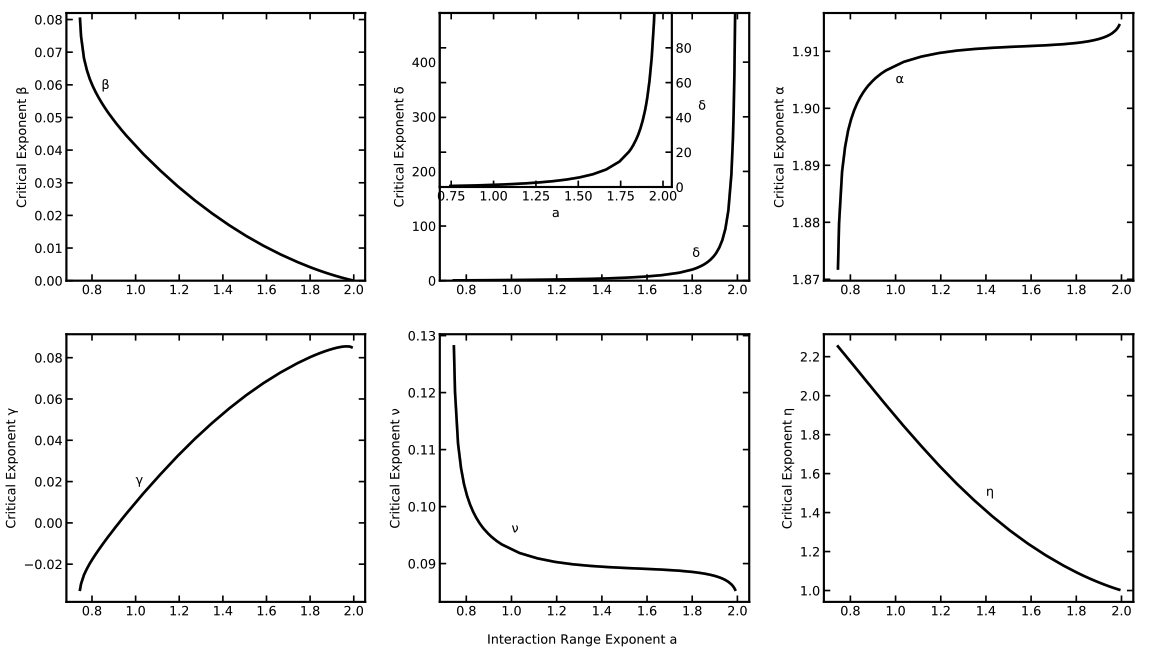
Our Ising-model preprint found both conventional magnetic order and frozen glassy order for suitable long-range interactions, but no alternating order: with every pair of spins interacting, alternation cannot satisfy them all. A follow-up preprint calculates magnetization curves and critical exponents across the whole range. The exponents change continuously as the interaction is made to fade faster or slower. In the inverse-square case the magnetization jumps at the transition while the specific heat shows an essential singularity, a hybrid of first- and second-order behavior that rigorous results had predicted.
In a published study of the spin-1 Blume–Capel chain, each site also had a nonmagnetic state. At some parameter values, cooling first produced a magnetized phase and then restored disorder as nonmagnetic sites became favorable. That return to disorder is an example of reentrance.
Publication
Ferromagnetic and Spin-Glass Finite-Temperature Order but no Antiferromagnetic Order in the d=1 Ising Model with Long-Range Power-Law Interactions arXiv:2508.11168, 2025
Blume-Capel Model in d=1 with Long-Range Interactions: Giant Reentrance in the Finite-Temperature Tricritical Phase Diagrams Physica A, 2026
Magnetization Curves, Critical Exponents, and Hybrid-Order Finite-Temperature Phase Transition of the d=1 Long-Range Ising Model SSRN · In review, 2026