Magnetism and phase transitions
Can a surface freeze on its own?
Spins at a surface have a different neighborhood from those inside. Can the surface freeze while the interior stays disordered?
We compared a smooth surface with sponge-like surfaces, which have many more connections.
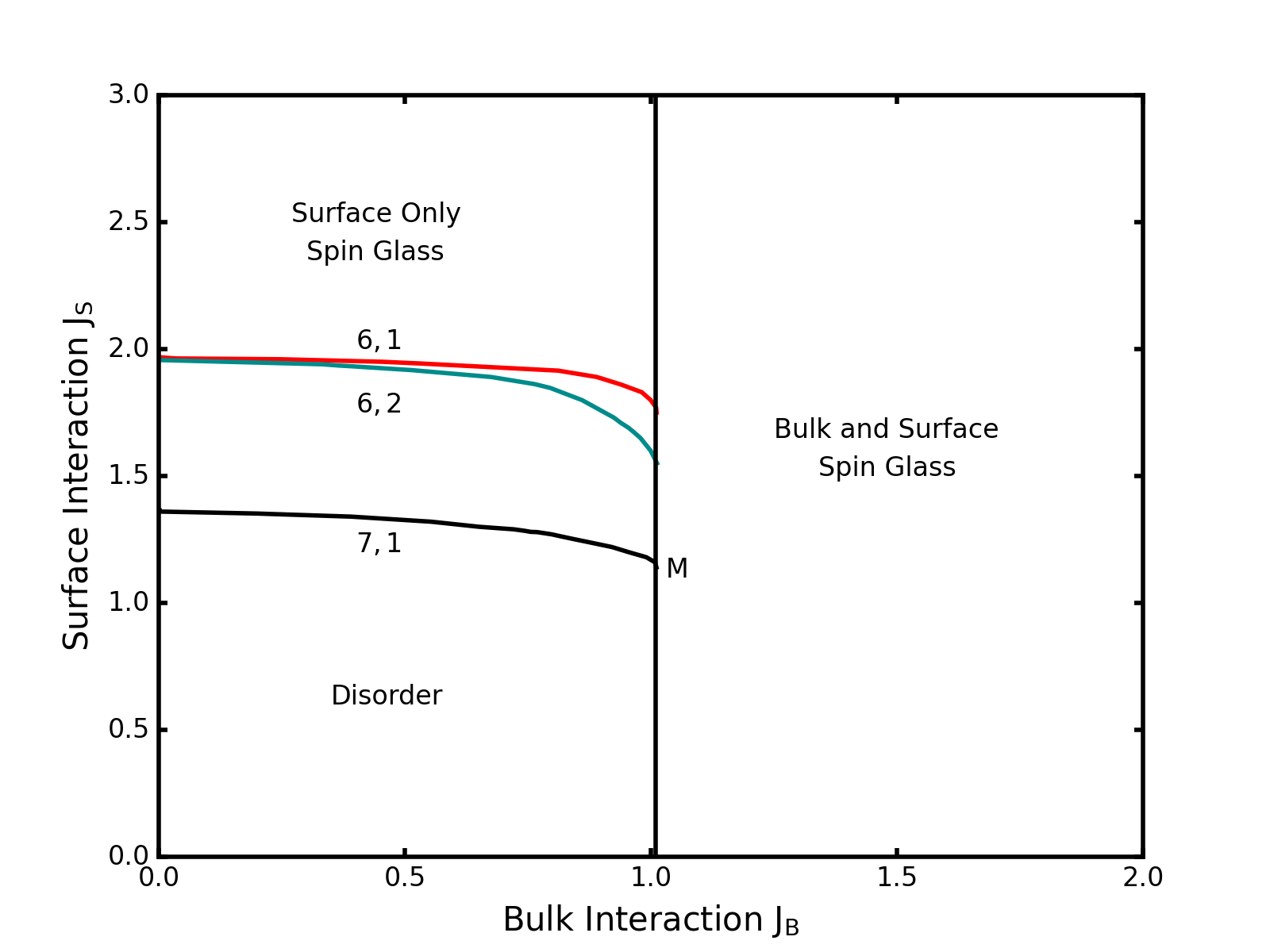
A smooth surface froze only with the bulk. A sufficiently connected sponge surface had a glass phase of its own, which meets the other two phases at a single point.
The atoms at a surface have a different neighborhood from those inside a material. Could the surface of a disordered magnet freeze into a spin glass while the interior remains disordered?
We varied the surface geometry in a three-dimensional hierarchical model. A smooth surface froze only when the bulk did. Giving the surface a sponge-like geometry with enough connections produced a separate surface-glass phase. At the point where this phase meets the other two, changing either the surface or the bulk interactions can determine which part of the magnet freezes.
Publication
Driven and Non-Driven Surface Chaos in Spin-Glass Sponges Chaos, Solitons & Fractals, 2023arXiv