Magnetism and phase transitions
What does the direction of a magnetic field do to a spin glass?
Each spin points along one of the coordinate axes, and competing bonds keep neighbors from agreeing.
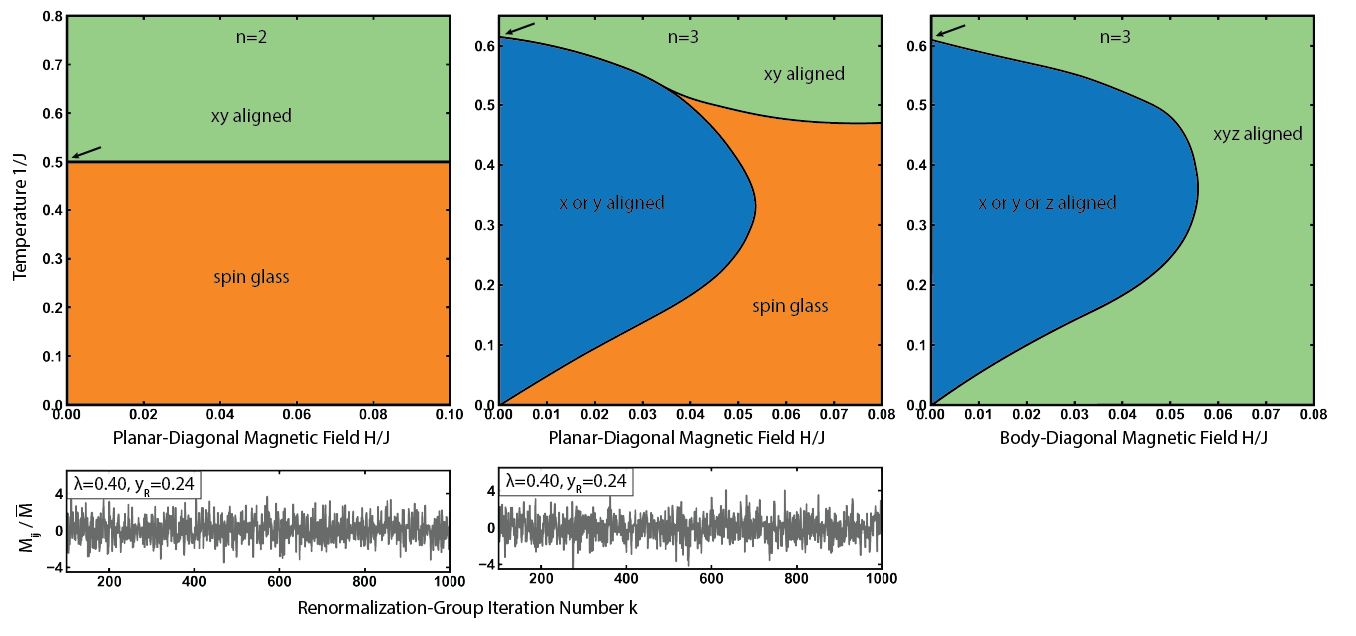
A magnetic field is applied along an axis, a face diagonal or a body diagonal. A diagonal field favors several directions equally.
Across the models we found 17 distinct phases. Under diagonal fields a glassy phase can continue from zero field or appear only once a field is on.
A magnetic field favors spins that point along it. In a model where spins can point only along the coordinate axes, a diagonal field can favor several directions equally. How does that choice affect a magnet whose bonds already disagree?
We compared fields along an axis, a face diagonal and a body diagonal. Across the systems studied we found 17 distinct phases. Diagonal fields left room for glassy order in two- and three-component models because aligned and alternating spin patterns could still compete. In some cases the glassy phase continued from zero field; in others it appeared only once a field was applied. The calculations are exact on the chosen hierarchical lattice and give an approximation for an ordinary cubic lattice.
Publication
Axial, Planar-Diagonal, Body-Diagonal Fields on the Cubic-Spin Spin Glass in d=3: A Plethora of Ordered Phases under Finite Fields Physical Review E, 2024arXiv