Magnetism and phase transitions
What forms when two rules for neighboring spins compete?
Each spin points to one of the hours on a clock.
One interaction asks only whether two neighbors show the same hour. The other depends on the angle between them.
Their competition gives five kinds of order. Odd and even clocks differ, because with an odd number of hours no position lies exactly opposite another.
Imagine spins at the hours on a clock. One interaction cares only whether two neighbors point to the same hour. Another distinguishes a small angular separation from a large one. What arrangements can form when both rules operate at once?
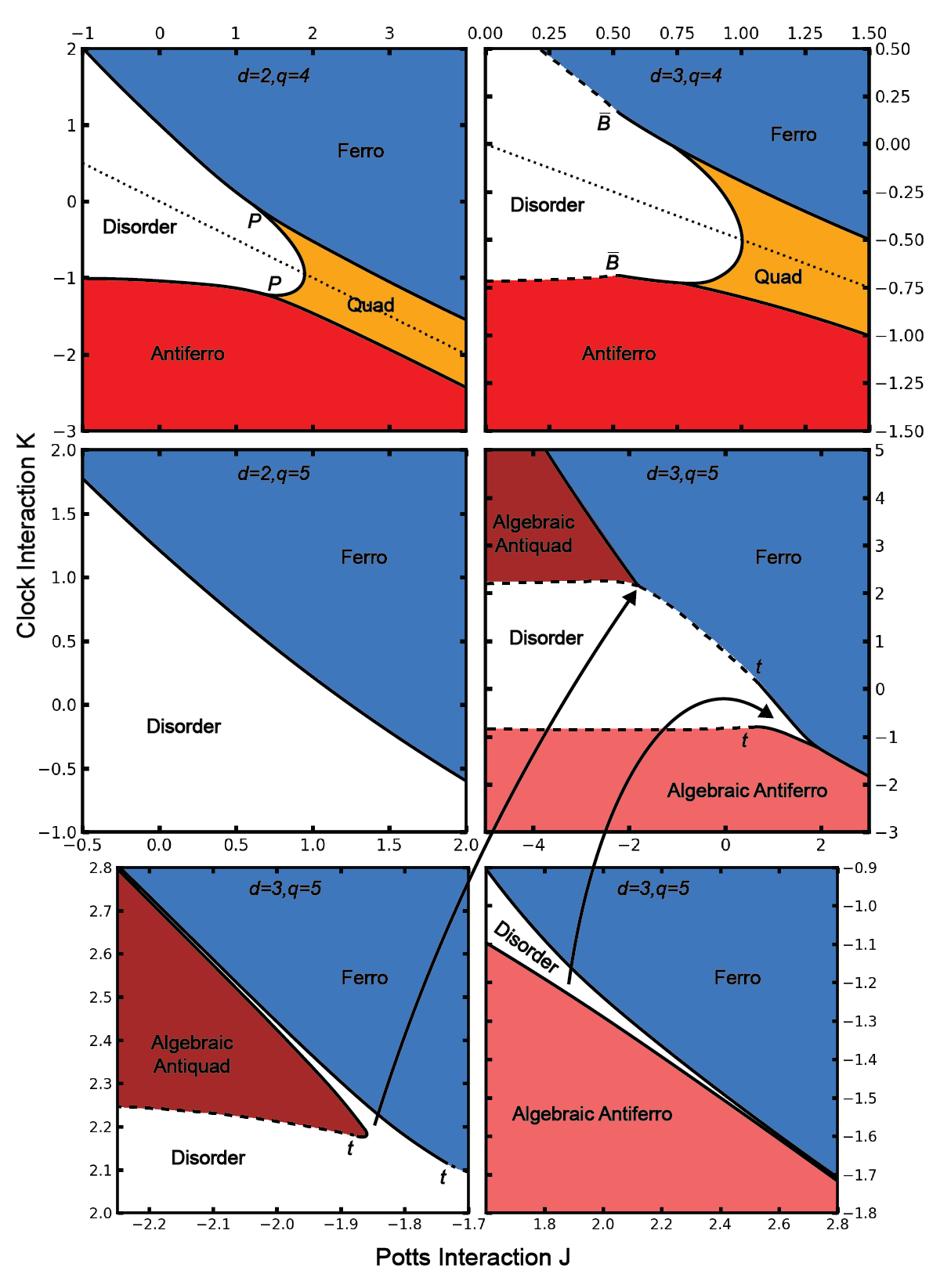
We combined these interactions in a Potts–clock model and mapped the competition in two and three dimensions. The calculations yielded five kinds of order, including two in which correlations decay as a power of distance. Whether the clock has an odd or even number of positions matters. With an odd number, neighbors that favor opposite directions cannot point exactly opposite one another.
Publication
Merged Potts-Clock Model: Algebraic and Conventional Multistructured Multicritical Orderings in Two and Three Dimensions Physical Review E, 2023arXiv