Magnetism and phase transitions
Can disagreement between neighbors grow as a magnet cools?
We count how often neighboring spins form each kind of pair, alike or unlike.
The pair probabilities are followed as spins are grouped into blocks, which shows detail that the overall magnetization hides.
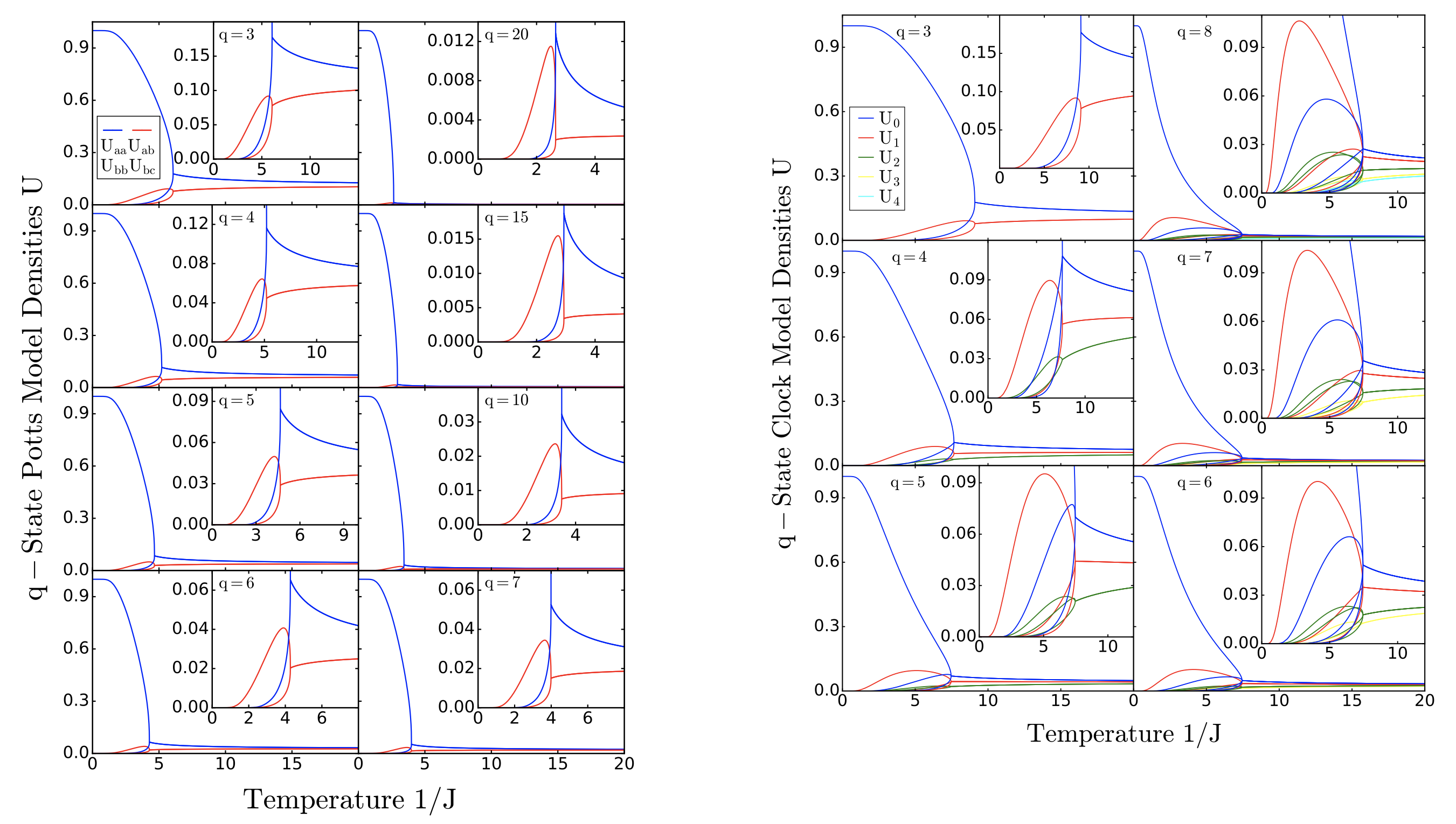
In an ordered state, certain unlike pairs become more common over part of the cooling range before vanishing at zero temperature.
As a magnet cools, neighboring spins usually agree more often. Can a particular kind of boundary between unlike neighbors actually become more common on the way to an ordered state?
We counted the probabilities of neighboring spin pairs in three-dimensional Potts and clock models. Tracking these local probabilities as spins were grouped into blocks exposed a detail that the overall magnetization hides. In a state with a preferred orientation, the density of certain unlike pairs rose over part of the cooling range before falling to zero at zero temperature.
Publication
Complete Density Calculations of q-State Potts and Clock Models: Reentrance of Interface Densities under Symmetry Breaking Physical Review E, 2020arXiv